by Jill Tietjen | Aug 1, 2013 | In The News, Newsletters
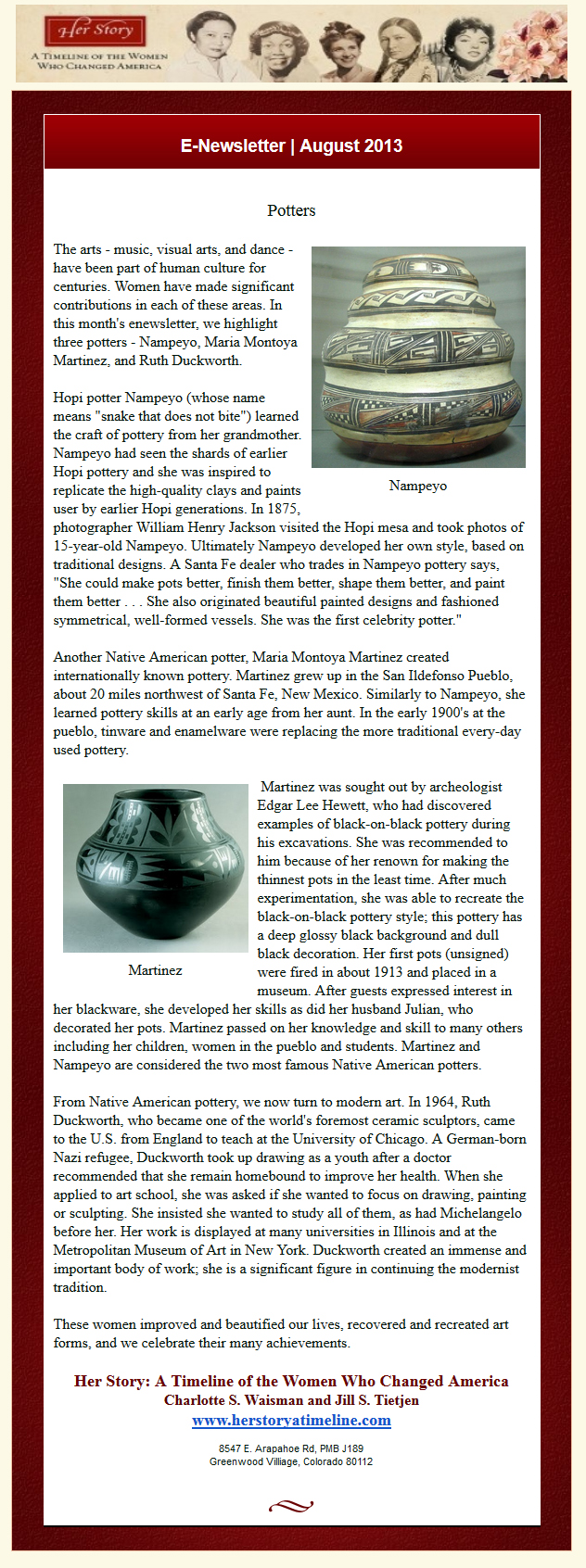
The arts – music, visual arts, and dance – have been part of human culture for centuries. Women have made significant contributions in each of these areas. In this month’s enewsletter, we highlight three potters – Nampeyo, Maria Montoya Martinez, and Ruth Duckworth.
To view full article click here 
by Jill Tietjen | Jul 1, 2013 | In The News, Newsletters
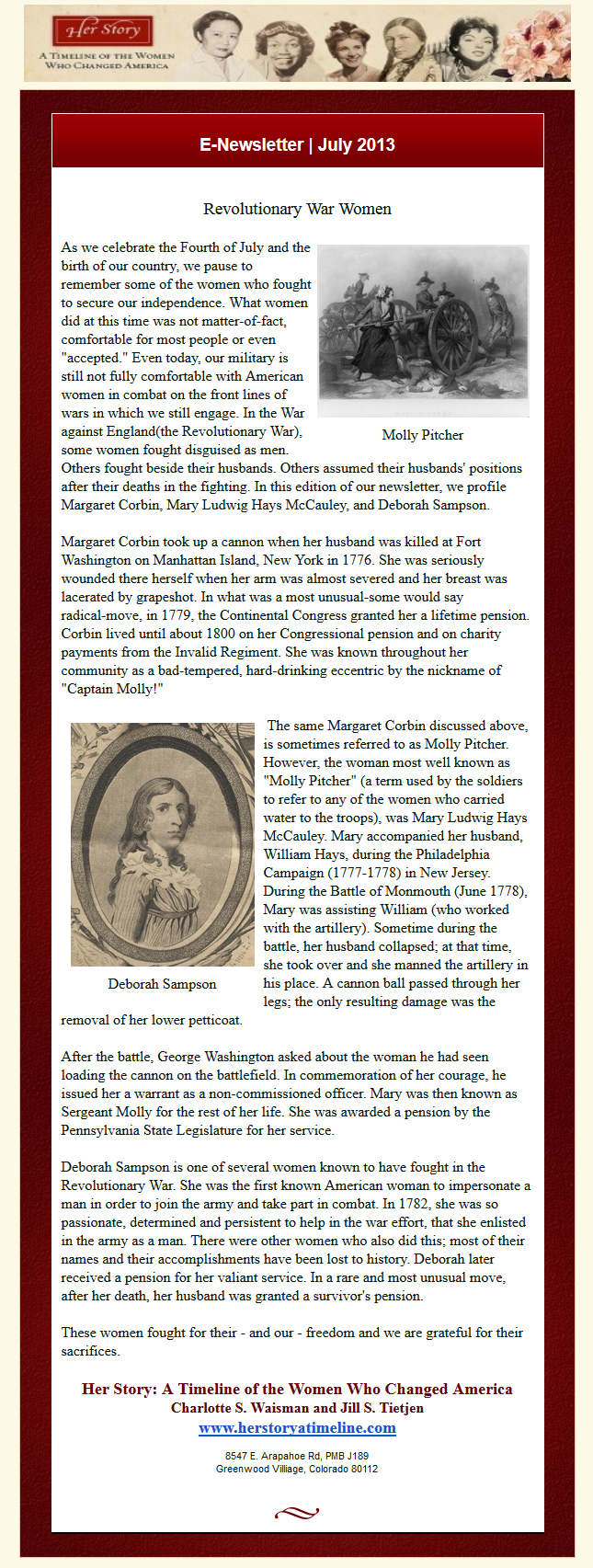
As we celebrate the Fourth of July and the birth of our country, we pause to remember some of the women who fought to secure our independence. What women did at this time was not matter-of-fact, comfortable for most people or even “accepted.” Even today, our military is still not fully comfortable with American women in combat on the front lines of wars in which we still engage. In the War against England(the Revolutionary War), some women fought disguised as men. Others fought beside their husbands. Others assumed their husbands’ positions after their deaths in the fighting. In this edition of our newsletter, we profile Margaret Corbin, Mary Ludwig Hays McCauley, and Deborah Sampson.
To view full article click here
by Jill Tietjen | Jun 1, 2013 | In The News, Newsletters
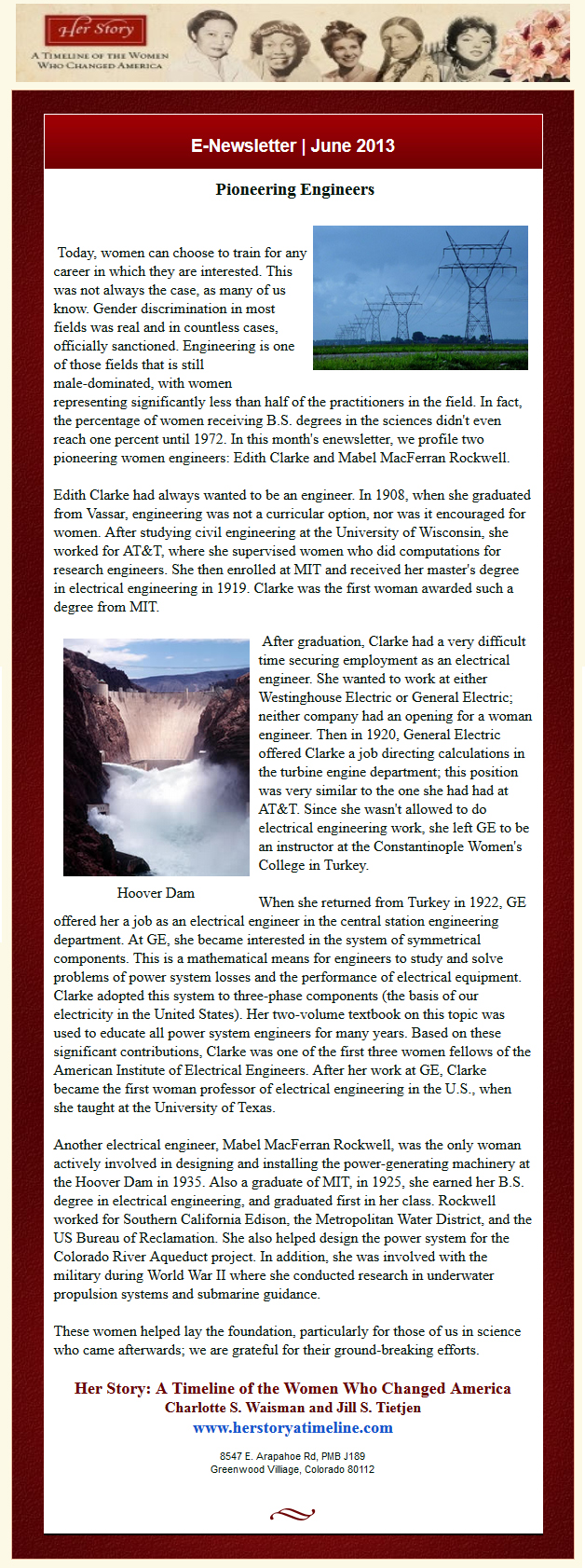
Today, women can choose to train for any career in which they are interested. This was not always the case, as many of us know. Gender discrimination in most fields was real and in countless cases, officially sanctioned. Engineering is one of those fields that is still male-dominated, with women representing significantly less than half of the practitioners in the field. In fact, the percentage of women receiving B.S. degrees in the sciences didn’t even reach one percent until 1972. In this month’s enewsletter, we profile two pioneering women engineers: Edith Clarke and Mabel MacFerran Rockwell.
To view full article click here
by Jill Tietjen | May 1, 2013 | In The News, Newsletters
Two women who are being inducted into the National Women’s Hall of Fame in October 2013 are profiled – Nancy Pelosi and Emma Willard.
For full newsletter click here. 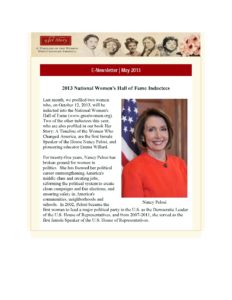
by Jill Tietjen | Apr 1, 2013 | In The News, Newsletters
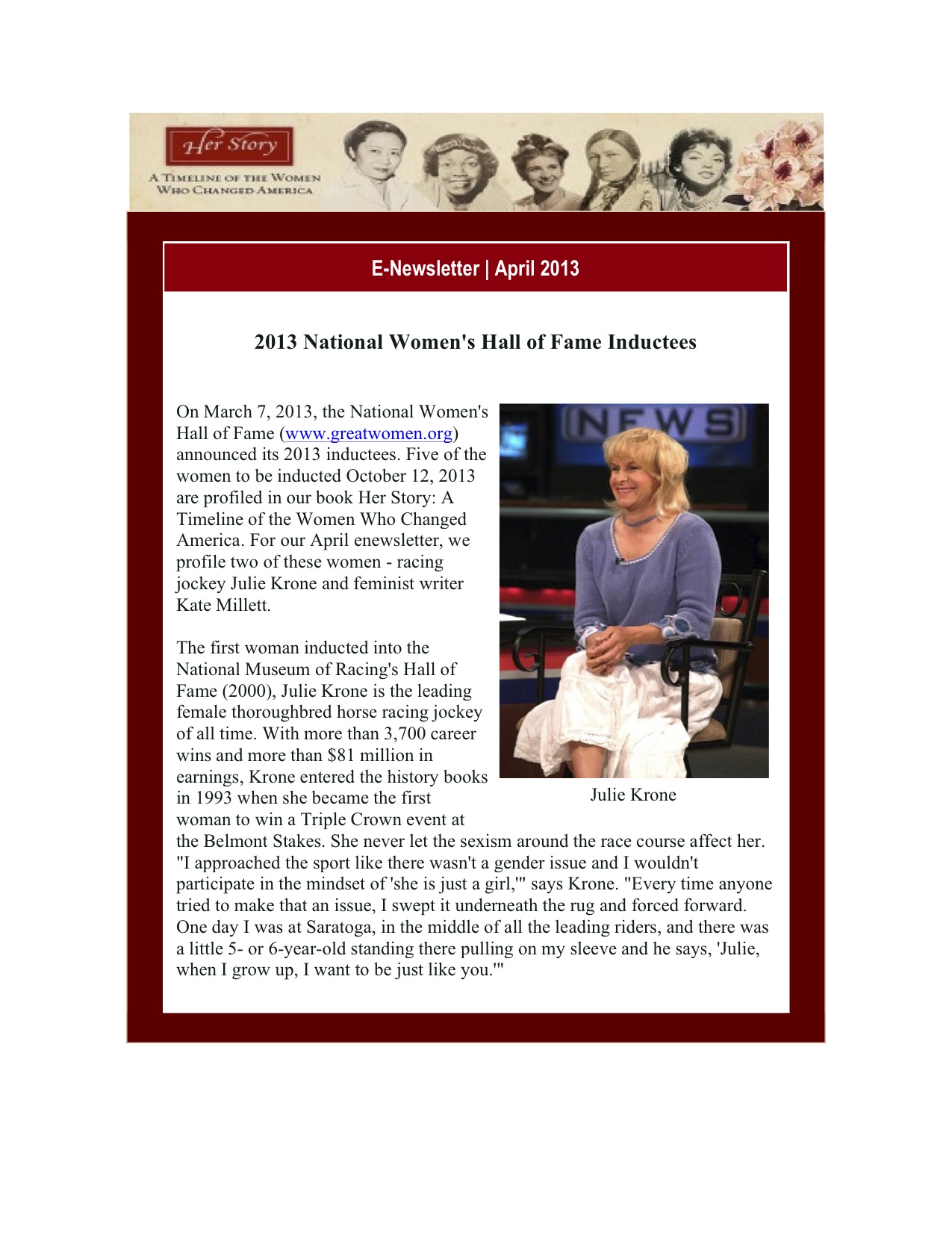
On March 7, 2013, the National Women’s Hall of Fame (www.greatwomen.org) announced its 2013 inductees. Five of the women to be inducted October 12, 2013 are profiled in our book Her Story: A Timeline of the Women Who Changed America. For our April enewsletter, we profile two of these women – racing jockey Julie Krone and feminist writer Kate Millett.
To view full article click here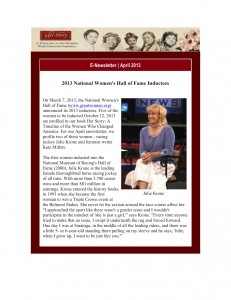
by Jill Tietjen | Mar 1, 2013 | In The News, Newsletters
With the release and prominence of the movie Lincoln, the U.S. public is once again interested in abolition and the intrigue and politics surrounding ending slavery. Women played a significant role in that fight as well. This month we highlight Mary Ann Shadd Cary and Angelina Grimke.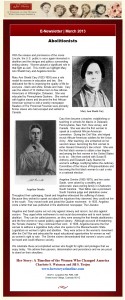
To view full article click here